
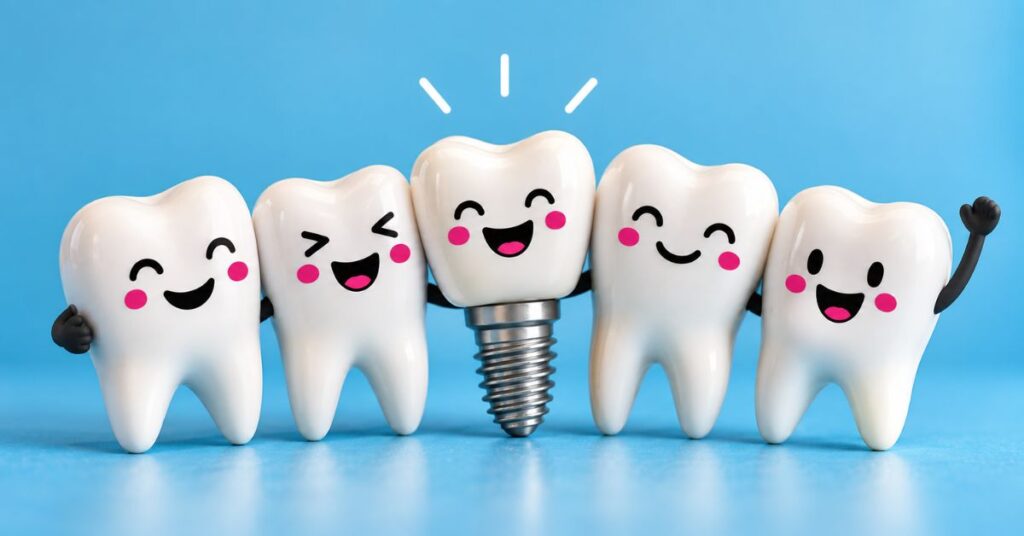
Teeth are surprisingly good at teamwork.
They bite together. Chew together. Help you speak clearly. Support your smile.
Most of the time, everybody knows their job.
Then one tooth leaves the team.
Suddenly, there’s an empty position.
And unlike the workplace, you can’t simply put an ad on Indeed:
Wanted: One molar. Full-time position. Must enjoy chewing.
Fortunately, modern dentistry has a much better solution.
Dental implants.
So, What Exactly Is a Dental Implant?
Let’s clear up one common misconception first.
A dental implant isn’t actually the replacement tooth you see.
The implant itself is a small post, usually made from titanium, that is placed in the jawbone where the missing tooth root used to be. Once it has healed and integrated with the bone, it can provide a strong foundation for a replacement tooth.
In other words, we don’t just fill the visible gap.
We rebuild from underneath.
A crown is then attached to create the part that looks and functions like a tooth.
The goal?
A replacement that looks natural, feels secure and gets back to work.
Because the rest of your teeth have been covering its shifts long enough.
Why Replace a Missing Tooth?
If a missing tooth isn’t bothering you, you might wonder:
Why do anything?
Fair question.
Depending on where the tooth is, a gap can affect more than appearance. Nearby teeth may gradually shift. Your bite can change. Chewing may become less efficient. And because natural tooth roots help stimulate the jawbone, bone in the area of a missing tooth can change over time.
Of course, every mouth is different.
One missing tooth at the back is not the same situation as several missing teeth—or a front tooth that suddenly decided to retire early.
That’s why the first step isn’t automatically:
“You need an implant.”
The first step is understanding what’s happening in your mouth.
Dental Implants Aren’t Just About Looking Good
Let’s be clear.
Looking good is nice.
We’re big supporters of looking good.
But dental implants are about much more than filling a space in your smile.
A properly planned implant can help restore chewing function, support your bite and provide a stable replacement for a missing tooth.
And because an implant is anchored independently, we may not need to rely on neighbouring teeth for support as we might with some other tooth-replacement options.
That makes dental implants an important option to consider when replacing missing teeth.
Option being the important word.
Because dentistry should never feel like ordering from a menu where somebody else has already circled your entrée.
Can Anyone Get Dental Implants?
Not necessarily.
And this is where good planning matters.
Your dentist needs to consider the health of your gums, the amount and quality of available bone, your overall oral health, the location of the missing tooth and other factors that could affect treatment.
Sometimes additional treatment may be recommended before an implant can be placed.
Sometimes another solution makes more sense.
And sometimes an implant is an excellent fit.
We know that’s not quite as catchy as:
DENTAL IMPLANTS FOR EVERYBODY!
But teeth deserve slightly more thought than a two-for-one pizza special.
How Long Do Dental Implants Last?
Dental implants are designed as a long-term tooth-replacement option, but they are not maintenance-free.
You still need to brush.
You still need to clean around them carefully.
You still need regular dental visits.
Yes, even your replacement tooth comes with responsibilities.
Welcome to adulthood.
While the implant itself cannot develop a cavity, the gums and bone surrounding it still need to stay healthy. Good oral hygiene and regular professional care remain important.
So no, getting a dental implant does not earn you a lifetime exemption from flossing.
Nice try.
Will My New Tooth Look Natural?
That’s certainly the idea.
The visible restoration can be designed to complement the shape, size and colour of your surrounding teeth.
Ideally, nobody should look at your smile and think:
“Excellent implant.”
They should simply see your smile.
Planning matters here too. Your bite, gumline, available space and neighbouring teeth all help determine how the final restoration should be designed.
Especially with front teeth, the little details can make a very big difference.
Teeth, it turns out, are quite particular about their neighbours.
What If I’m Missing More Than One Tooth?
Dental implants aren’t limited to replacing a single tooth.
Depending on your situation, implants can also be used to support bridges or certain types of dentures.
That means you don’t necessarily need one implant for every missing tooth.
Which is another reason why an individual assessment matters.
There are different ways to rebuild a smile.
The right one depends on your mouth, your health, your priorities and what you want the final result to accomplish.
At You First Dental, we think you should understand those choices before making one.
There’s that You First thing again.
Funny how that keeps happening.
Thinking About Dental Implants in Airdrie?

If you’re missing a tooth—or several teeth—you don’t have to arrive knowing whether dental implants are right for you.
That’s our department.
Your job is much easier.
Come in.
Tell us what you’d like to change.
Ask questions.
We’ll take a look, explain what we see and talk through the tooth-replacement options that may be appropriate for you.
No dental dictionary required.
No pretending you already understand words like osseointegration.
Although now that we’ve mentioned it, you can casually use it at dinner tonight and impress everyone.
“Could you pass the potatoes? Also, osseointegration.”
You’re welcome.
Missing teeth don’t have to stay missing.
And if dental implants are a good fit for you, they can provide a strong, natural-looking way to get your smile—and your dental team—working together again.
At You First Dental in Airdrie, we’ll help you understand your options.
Then, as always, we put YOU FIRST.